

Skytrac fabricates and stocks parts for Skytrac, CTEC and many other lift brands.
Click here to check out parts and compare prices in our parts showroom or download your catalog.
Meet Alex McCann, your Parts and Customer Service Manager:

Alex McCann — Parts & Service
(801) 972-1699 ext: 313
alexm@skytrac.us
IRMA: John Dalton, Part II – What My Fixed-Grips Looked Like After the Hurricane Hit
September 6th was the day Hurricane Irma hit St. Maarten.
Our eco-park was ten days away from opening with the two new fixed-grip installations having already run for ten months during construction. The lifts were explicitly designed for hurricane forces, and although we knew they would get tested, we didn’t think that would happen so soon.

According to the United States National Hurricane Center (NHC), “a Category 5 Atlantic hurricane is one that is considered to have had sustained wind speeds greater than 136 knots, 157 mph, on the Saffir–Simpson scale.” Hurricane Irma winds were sustained 185+ mph with its arrival at St. Maarten with gusts to 235 mph – strongest ever recorded in the Atlantic basin.
Pre-storm countdown
Five days out.
It looked like Irma was going North of us with the potential to be serious. Our first move is we cleaned up the park’s site as there was a lot of loose construction debris that would fly around in the high winds.

We saw the hurricane was approaching closer to St. Maarten and getting increasingly dangerous. We put additional planning into place and began placing concrete blocks on top of containers, lighter objects, and exposed equipment. We started pulling chairs off of Lift #2, which is the upper lift on the mountain, using shipping straps with trucker ratchets to belt down the nested chairs. We did leave a few chairs on for access to the summit during preparations. We also began taking chairs off of Lift #1, our base area to mid-station lift, with other tasks taking place simultaneously.
Three days out.
It was on this third day we sent our crews home and kept just a skeleton crew to keep the progress moving forward. The staff needed to take care of their own homes and secure their family’s safety. With those matters complete, they could come back and proceed with park preparations.

Lowered ziprider cables into the bush.
Two days before the hurricane hit.
The second day prior the storm was quite busy. We finished packing the chairs on Lift #1 in earnest, leaving four access chairs for tools and workers on the lift. We strapped down the motor room covers in tandem with preparations for our zip rider. There, we lowered the cables and all the retrieval lines down to the ground, then tied off the cables so they wouldn’t flog themselves to death. Where the equipment was adjacent to steel structures, we tied them off and then lowered the rest of the cables into the bush. Back down around the base area, along with the other employees, we secured the doors, screwed plywood up and around the windows, closed the hurricane shutters and fastened boards across them to make sure everything was good and tight.
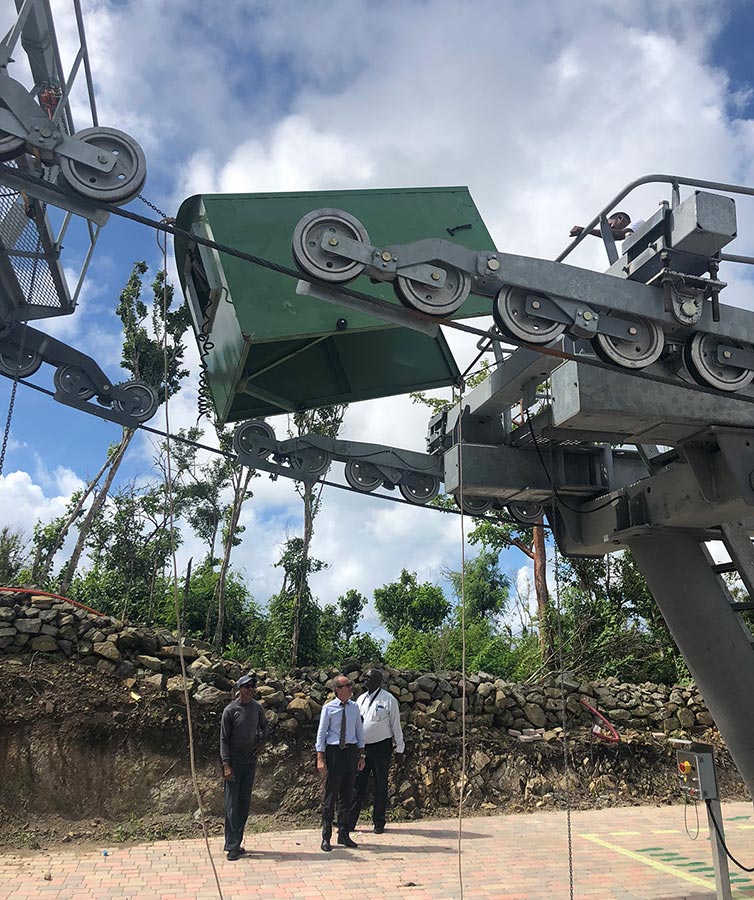
Motor room cover getting reinstalled.
One day countdown to zero hours.
We spent the last day taking the remaining chairs off the lifts. We wrapped and secured all of the control boxes and anything electrical in heavy-duty plastic covers. Most of the remaining work was allocated to the decking and construction supplies at the top of the mountain as we tucked everything away and screwed everything down. At that end of that last day, the General Manager, Shaydar Edelmann and I were the last two people at the top of the mountain to finish up and do final inspections before we rode down to the base in AT vehicles. Then we said a prayer, wished each person good luck, and everyone went to their hiding holes for the storm.

Plantation house survived with roof intact and minor nicks and cuts

Leaves coming back.
I went back to my boat late that afternoon before the storm hit as we received a notification that it was going to be a Category 5 with winds over 157mph going right over the top of us. I packed up all my paperwork, electronics and valuables and moved everything, along with myself to a friend’s villa. This particular home structure survived twenty years ago through Hurricane Louis, also a Category 5 and a very violent storm. Here is where I holed up, and in fact, I’m still there today because my boat flew away. A bit of a heartbreaker but fortunately insured.
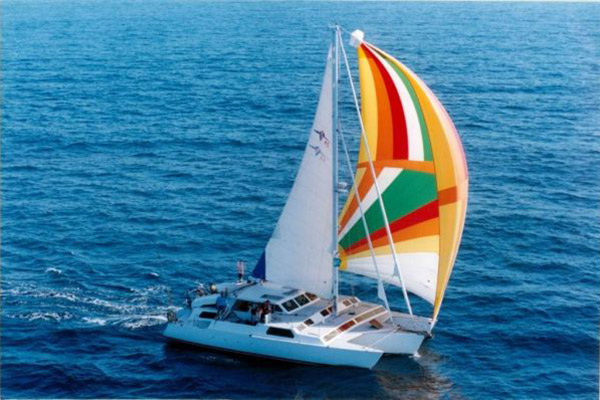
My boat from last year’s article.

Found my boat.
After the storm
After the storm, transportation was very difficult. I was in a location where I couldn’t drive to the park. I had word from Mike Walker, our operations manager, who had hiked across the island to see what happened there and the news was very positive. The buildings in the park all survived with just nicks and cuts. The park didn’t lose any roofs, and we didn’t have any blow-through water damage, only very minor stuff. We did lose our Tubby Tube Run. We had modified the design of the tube run to handle high winds, but Irma was just too much for it. The Run was constructed from fabricated sheet metal and when the wind got underneath it peeled up like a strip of tape and flew into the forest. That equipment was a total write-off.

First look at cable.
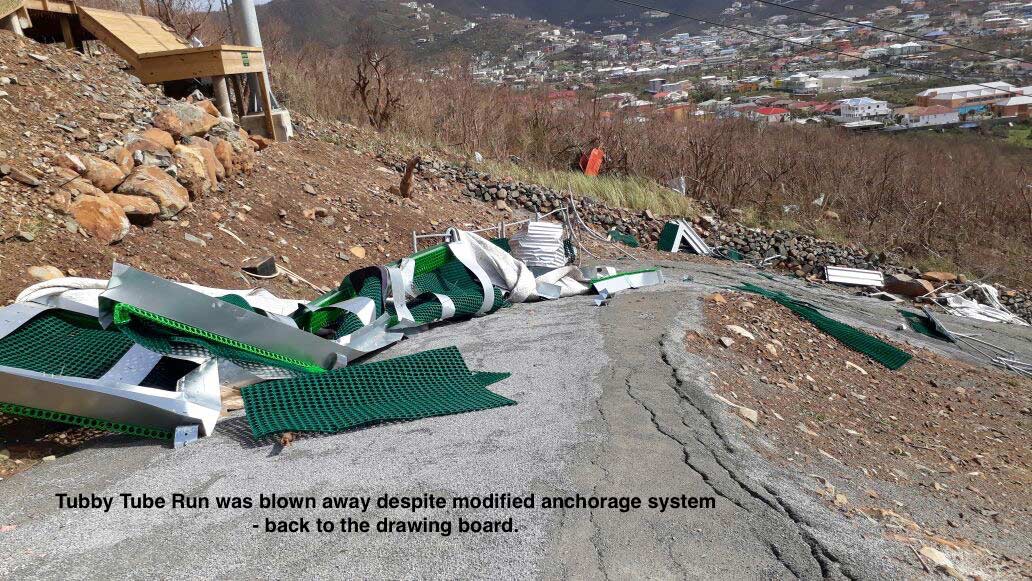
What’s left of the tube run.
Lift #2 was our second biggest hit. Its location is in a saddle on the ridge, so it sits in an area where the wind accelerates as it funnels through. We found the cable on the ground 100‘ off of the lift line. From what I surmise after seeing it in detail, I believe a huge gust blew the cable off to the side and when the cable rebounded it jumped off the bullwheel before bouncing around to its limits and finally coming to rest on the other side of several 35 ft trees. It destroyed both of the pressure transducers on the hydraulic tension system and caused cosmetic cracking in the machinery grout where the frame flexed. How this damage occurred was very impressive, I’ve never seen anything quite like it.
Hurricane design
In the last article, I spoke about how I worked very closely with Skytrac to come up with a hurricane design that was still economically feasible. I’m happy with the design what we came up with because it pretty much worked as planned.
The plan was that our towers were to be heavily loaded. The main idea is if the storms are not too aggressive, the cables were going to stay put. If the storm is too destructive, the leeward side is going to blow off the tower. We had to make the tower strong enough for the force on the windward cable to be resisted and not bend the tower. If the towers bent or failed, the material costs would be astronomical to fix as it would require a long ferry for a heavy lift helicopter. We recognized that the sheave trains and tower components could be replaced piece by piece if necessary, so we focused on strong towers. The guys at Skytrac shipped out the replacement parts right away. In the mean time, we dragged those cables back under the lift and hoisted them back on the sheaves, bending components back into alignment well enough to turn the lift again until parts arrived. We were most concerned about the cable itself because it was jammed into one of the sheave trains and wedged between a sheave and an interior anti-derail. Once we got that cable out and under tension, it didn’t look as bad. Terry Zakotnik from Above & Beyond flew in on a special charter flight to do magnetic resistance testing on the cable and straighten out a few wires. When we got a clean bill of health on the cable, we started turning it the lift in earnest.

Ironwood tree. Known as the hardest wood in the world, has a hardness of 5,060 lbs per foot.
Electrical mysteries.
After the storm, there was one tree in particular that we noticed, called an Ironwood tree. Like its name, a very dense, hard, strong, and heavy tree.
It looked like the cable got hung up on it during the storm, as it was lying at the base of the tree trunk when we found it. The top of the tree was blown off by lightning, all scarred and scorched.That’s at least one lightning hit we are aware of. Once we got the lift running on the diesel engine, we started through the safeties and after changing a card cleared all the faults through the PLC. We didn’t realize initially but the lightning strikes had affected the majority of the system. Getting into the guts of it, there were melted cards and drive components among and other issues, so we had to replace the whole drive.
Rebuilding by camera phone
The tech support with ABB along with the electrical support from John and Wu from Skytrac was amazingly helpful. Shaydar and our electrical team put in some very serious effort to get through replacing the drive, resetting parameters, troubleshooting, and finding all the burnt relays to be replaced. Located far from supply sources and technicians on this island, where we will have lightning problems in the future, it was a valuable learning process on how to deal with lightning strikes and what components we are going to have to carry on the shelf.
I found it amazing that we replaced a drive ourselves using only phone support. WhatsApp was a very useful tool. When you can point your phone at the board and say “Look, its burnt over here and this lights not on” and you’ve got John on the other end looking at the problem, it’s second to him being right there with you.

Getting cable back on.
We are looking at putting lightning clamps on the cable and better earthing – that gives the lightning an easier path to ground instead of through the drive – hopefully. Short of an electrical grounding system like they’ve got in Telluride, at a prodigious cost, it is more economical for us to put parts on the shelf.
At the first assessment after the storm, I will admit that it was a bit intimidating. We sent photos and called Dave Metivier (President of Skytrac). After discussing the situation, he put Alex McCann (Parts and Customer Service) on a plane and sent him down. After a complex series of flights, he finally showed up. Alex was a huge help in getting the cable back on and going through all the mechanical components. Knowing the parts intimately helped us with the list of everything we needed. We consider ourselves extremely fortunate as many of the businesses here in St. Maarten are going to take a year or more to recover. I don’t know why we deserve to come out so well compared to others, but we’ll take that piece of luck.

Above the carnage.
We have 700 square meters of wood decking at the top of the mountain that amazingly stayed put. There was one section of stairs that flew away because it wasn’t bolted down yet, and we never did find it.
Now, with the lift is locked out, we de-tension and lower the chairs so the passengers can just step out of their seat and onto solid ground without the use of evacuation ropes. We performed evacuation practice using the new method and were very happy with the result.

Single span, Lift #2
The future of business
We are going to have a tough season coming up. Our projections were for a full-on tourist season, and we were expecting to use the revenues to service our loans. Next season I believe we’ll be back at about 90 percent with tourism. No one is sitting still and St. Maarten is recuperating quite well.There is aid coming from Holland. Tourism operators and cruise lines are committed to rebuilding and are anxious to get back in full force. St Maarten is an important destination to these industries and has a will to build back, better.

First ride post Irma.
Takeaways
It is the first time I‘ve ever been in a major hurricane like this and I was encouraged by the way people came together to help each other. These challenges have had positive aspects. Our crew has taken ownership of the park here and stepped up to protect it from the storm which bodes well; they are very proud of what they’ve built here, as they well should be and are thinking of their future with the park. Although there is still finishing work being done, we opened for business on the 24th of November after a two month hurricane delay.
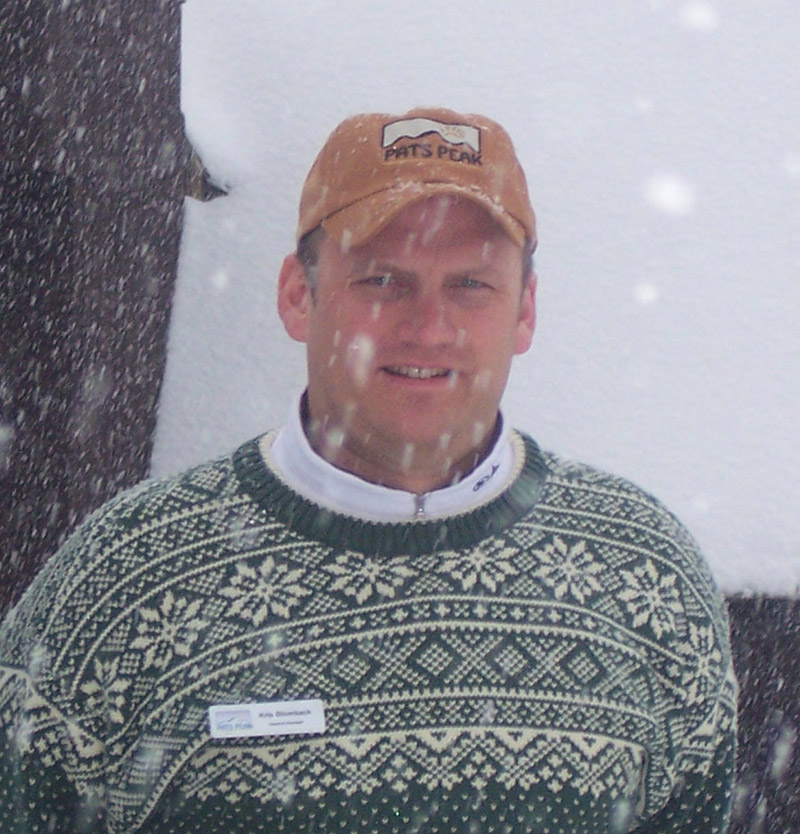
GM of Pat’s Peak, Kris Blomback – Unfiltered
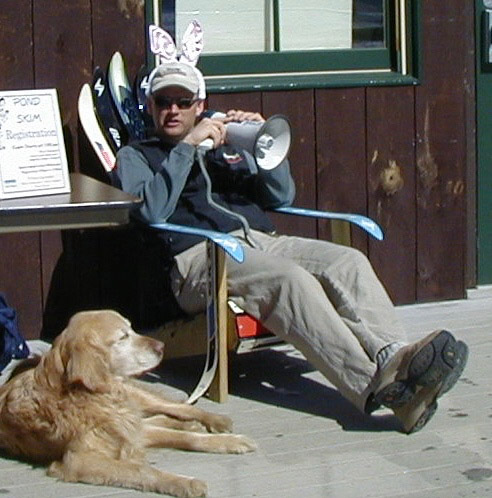
We’ll take our Kliffy, straight up, hold the ice. Here’s the story.
“I’m a flatlander from Long Island, New York and the youngest of three boys. My parents were of Scandinavian heritage so everything was ski-oriented and all vacations were ski, ski, ski. There was no negotiation on that. Every Christmas week we’d go up to the Berkshires, go to Catamount, Butternut, Bousquet and Jiminy Peak. That was always the Christmas vacation for probably fifteen years in a row. Next came the “big trip” to southern Vermont. My family would stay at the Village Inn in Landgrove, Vermont for a week, where we’d ski Stratton, Bromley, occasionally Okemo, then every once in a blue moon, Killington. My mother didn’t like Killington because she thought it too big and intense. She liked Bromley because she could keep an eye on the family. My parents enjoyed Stratton because at the time they had the Stratton Mountain Boys who were a Tyrolean-style band that played traditional Austrian music. My parents were really into the European dancing and all that crap.”
You attended Lyndon State. Was your goal to run a ski resort?
“We’ll back it up to skiing at Bromley. My dad was an aerospace engineer at Grumman Aerospace so he, of course, wanted me to go into engineering. Apparently, I was successful in never showing him my math grades. My dad was engineering-oriented in all ways, so if you presented a problem to him, his mind would think analytically to figure it out. I remember riding the chairlift at Bromley back in the early 80’s and my dad said to me, “Well son, you’re 15. What do you want to do with your life?” And I answer, “I don’t know. I think running a ski area would be a pretty cool thing.” He said “Okay,” and I went off and skied with my cousins and my dad skied off with the adults. Later we met at the base lodge, finished lunch, but before we headed back off to the slopes, my father says, “Hey wait, before you go back out, you have a little project. I’ve arranged for you to have an interview with the president of Bromley.” I was like, “Daaad! What are you doing to me?” Here you are at fifteen, insecure; you have zits, you don’t have your place in the world yet. My dad also arranged an interview with the guy who was running Stratton, so over a period of two days, I interviewed these guys.
My first interview was with John Cueman, who was then the president of both Bromley and Magic Mountain. During the appointment with him, he instructed me to get a degree and then come back and see him. And that’s what I did, and how I landed my first job at Magic Mountain.
Second interview: I was always just this big passionate skier so I will never forget the crushing words from the guy at Stratton. Do you remember Stratton Mountain when they had the big red sweaters with the Austrian eagle? It’s a very vivid picture in my mind, this guy was a big wig in the company, sitting there dragging on his cigarette during the interview, with this big personality, and a big red sweater with the Austrian eagle. I went to ask him, “What’s the most exciting thing about running a ski area?” He put his hand up to stop me in the middle of my question, pushed his cigarette out in the ashtray and said: “What you need to understand first and foremost, is we are a real estate development company first, and not a ski area.”
I thought I was never going to be able to pick my heart up off the floor. I said, “What are you talking about? The skiing is everything!” I’ll never forget the disappointment that I felt. I’ll never forget it. That meeting has been part of my DNA from there on out. I always considered myself a business guy, but first and foremost I consider myself a caretaker of this facility and want to make sure I leave it like a Boy Scout–better then I found it. Then I worry about the profitability and then worry about all the other stuff. I always believe in doing the right thing long term, for the SKIING experience. That’s kind of where I’m at. That negative experience is how I figured it out. I went to college and dumb enough to stick around, and survived.”

1993-ish. Rockin’ it early Pearl Jam
Lyndon State College
“My graduating class was pretty good one at Lyndon State. Bruce Schmidt was a suite-mate who lived one door from me in the dorm. Bruce was my little cluck’n redneck who is now the GM at Okemo. Then we had Jamey Wimble, who was the GM at Mad River Glen and finally Scotty Reeves who is the VP of Operations at Stowe. We were all within a year of each other.”
Magic Days
“I began my career at Magic Mountain from 1985 until about 1991. I started out in snowmaking for four to five years. As I would actually show up for work, I was made a shift supervisor and then ran the night crew. When I got out of college, I got the snowmaking supervisor job, in charge of the snowmaking plant. At that time Magic ran into financial trouble, and we were trying to straighten the ship, I was given Timberside, the backside of the mountain to manage. That was when I started cutting my teeth as a lift mechanic as well as snow-making and giving a hand with grooming. When Magic closed I came over to Pat’s Peak in charge of snowmaking and lift maintenance and then worked my way up for three or four years and was offered the opportunity as GM.”
So when we speak to younger people entering the industry today, this route you’ve taken by educating yourself, coming up through the ranks of ops…do you feel that path can still land you a GM’s job?
“It’s a pretty unique industry as you know. If someone was looking to get a GM job and was looking to work at Vail, I’m not sure I would start out as a snowmaker. Your claw up the rope would be pretty arduous. There’s a lot of luck involved that I was able to get one of these coveted GM jobs, but I’d also like to think that I worked my ass off to get to this position. What I find a little frustrating– though I certainly do not want to sound like my father– the ski business is a pretty complex animal. I think the biggest thing to let the next generation know is they need to put in the time and have the patience to stick it out. Someone can’t just be given the keys to the facility, as you can’t teach experience, you can’t teach how to fire people, you can’t teach how to work with different personalities. There are a lot of things you gain by just doing.”

1991:The first year at Pat’s with Kasey
Life at Pat’s Peak
“Why is Pat’s so successful? It’s the “chicken soup theory“ of ingredients. We’re one of the most accessible ski areas, except for Wachusett and Nashoba coming out of Boston, but we’re next up on the totem pole. As the commute here is all highway, our tagline used to be, “There’s one stop sign between the Big Dig and Pat’s Peak, what’s stopping you?” We’ve got committed ownership with the Patenaude family. The family has always been in support of capital improvements. I like to think that I’m a pretty frugal guy and don’t spend money very easily. We’ve got after-school programs that fluctuate between 7,500 and 9,000 skiers and riders every week. We keep a larger than normal staff for an area our size. The owners and our team are very meticulous that the place is looking good. We want the walls painted, and the carpets changed, lifts painted, and we always try to do something new and exciting. I’m a believer that to keep things fresh; you have to present four to six ideas that keep the skiers coming back. It’s kind of a silly business with the amount of capital dollars you got to put into it. A big shout out to our snowmakers as we probably have one of the most powerful snowmaking systems in the New England per acre. All of it together makes for a great recipe.”

Kliffy and Roxy on their daily walk-about.
Where’d you get your name Kliffy?
“Back in the Magic Mountain days, Jim Shultz, who was the Mountain Manager was looking at purchase order sign-offs and asked the parts manager, “Who’s KB?” The parts guy says “yeah, uhhhh.. that guy you just hired for snowmakin’? Kliffy Bromberg?” He said that in front of like three lift mechanics and snowmakers. You know op’s guys. They ate that up for dinner, and the rest is history.”
Family
“I have a very lovely wife Jennifer and my daughter Halle is in college. Halle likes the slope-side location of my office. During Christmas week my office is packed with cousins and jammed with ski boots and clothes and equipment all over the place. I enjoy the chaos that family life brings. It’s what its all about isn’t it?
And yes, Poppa did get to see me as a General Manager of a ski resort. He was a proud parent of all of his three boys. We all “done good” before his passing in 2013.”
Hilltrac’s Newly Launched Website and Video Footage

Skytrac has launched a new website and video specifically for the Hilltrac Automated People Mover (APM). This is a transit system powered by green technology and engineered to perform both vertical and horizontal curves while traversing virtually any topography.
Mountain Ops in the Hudsonian Life Zone of Arizona Snowbowl

Dale Haglin shares his 34 years of know-how, facts on reclaimed water, and, hold the salt, Snowbowl uses volcanic ash.
“Arizona has all six of the of the Merriam life zones, starting at the driest of desert zones all the way up through the Sonoran’s of Joshua tree and sage brush to the Hudsonian Life Zone where Arizona Snowbowl is situated. So the state is not all desert, as many believe. Arizona, interestingly enough, has the largest ponderosa pine forests in the U.S. It’s fantastic too because from the tops of our chairlifts you see the North Rim of the Grand Canyon.”

AZ Snowbowl’s unique, winter supporting life zone sits high above the desert floor.
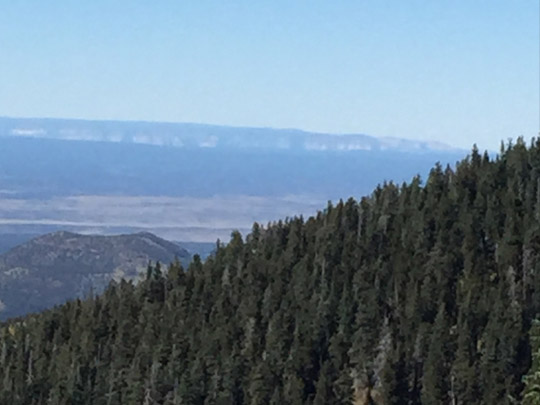
A chairlift view of the North Rim of the Grand Canyon.
How’s life with a detachable?
“We think it’s incredible, but I’ll start with the quad lift we put in a few years ago as it started the progression on how this mountain skis. The situation at Snowbowl is that we have enough parking up here for roughly 1,400 vehicles. When the parking lots were full, our lift lines were huge. So when the new ownership decided to fund the Humphrey’s quad, it completely changed our operations world because it opened up a whole new area of the mountain that had never been. Snowbowl has 777 total acres, so the mountain’s not huge, but we have some pretty decent vertical drop at 2,300 feet. We still had our higher level intermediate and experts skiers going to our Agassi Lift, which is a fixed grip triple and was our main lift. When we installed the new six-pack last year, there were no longer lift lines on the mountain. It just completely changes the way the whole mountain skis. It pleasantly shocked everyone and was our big game-changer. And .. the trails still had plenty of skier room. Last season was our record year. We had good snowfall, the new lifts; it worked out well. It was exciting for the employees and locals as all these years the upgrades weren’t just something we talked about or something other resorts did. We could see a lot of line items on the master plan come to fruition.”

Construction of the LPoA detachable.
Water
“Another milestone for this resort was our ability to use reclaimed water for snowmaking. It’s all grade-A, recycled water that the resort uses and while it transformed the mountain, it’s very expensive. We’ve been making snow here with this new system for four or five years now. We pump the water from the town where it goes through three different pumping stations, and we pay for every drop of water we use. Water is very precious in the Southwest, so we don’t take the use of it lightly. From our perspective, we believe recycled water is a proper use from the standpoint we are not using potable. It’s worked out well. There are just a few resorts other than Snowbowl that use reclaimed water. Interestingly enough this past season the meteorologists called for a La Nina type winter, which is warmer and drier. Then we got hammered with snowfall with over 300 inches. In the past, there were seasons we’d only be open for three days for lack of snow and other years we’d receive 450 inches.”

Natural snow, 300 inches of it fell this past season in what was to be a La Nina winter.
“I was born and raised in Flagstaff the town closest to the resort. After high school, I worked here at the resort alongside another job for a candy and tobacco wholesaler for seven days a week to pay for my degree at Northern Arizona University. Working full time, I got a lot of opportunities to operate heavy equipment and snowcats. I got on ski patrol eventually, then trail crew, and lift installs. The first management position was assistant grooming supervisor, to grooming manager, then vehicle maintenance. Management kept adding to my plate, so eventually I was responsible for all of the mountain operations.
“I’ve got a wife, three children, and one grandchild. Both of my daughters are nurses and work here at the local hospital. My 21-year-old son works at a local golf course, runs a groomer in the winter but plans to be a cop. All of our kids are skiers.”

Volcanic ash cinders for winter road maintenance
Unique to the mountain
“Our access road is seven miles of a U.S. Forest Service road and we have a special use permit to be able to use it. It’s the resort’s responsibility to provide the winter maintenance and we don’t use any chemicals or salt to melt the snow and ice, we use volcanic ash cinders. We haul these cinders during the summer and it usually takes two and a half months to beef up the stockpile for the winter, so that we’ll have enough. The Forest Service provides the cinders from a local pit about eight miles away from the ski area where we dig it out of the hillside. The material is pure and doesn’t need screening before use. On this same road, we haul every drop of our potable water with a water truck and a dedicated driver. He moves over a million gallons a year just for drinking and fresh use in the lodges and buildings.”
Why I do what I do
“One take away from this industry is that so much has changed with grooming, lifts, technology, etc. The coolest thing I believe is that the people have not changed. They are a community with plenty of respect for each other for what they accomplish in the mountains. I think a lot of times the ski area operators may not get enough credit for what they do and the type of people they are but deep down it’s the folks like you and me that know the true story. I think that’s part of the uniqueness and the motivation of why we continue to show up every day.”
See You All in September!
New England Summit, SANY, PSAA, SSAA,
NSAA Fall Meetings and Shows
http://www.nsaa.org/events/fall-education-seminars/fes-home/
Hilltrac Informational Video
Bill Brett’s View From the Tower

 Bill Brett, the now retired mountain manager from Timberline Resort, OR, is the 2017 recipient of the PNSAA Tower of Excellence Award.
Here’s his story on lift mechanics in some of the U.S.’s toughest weather.
“Here at Timberline, we built the first Palmer lift; a Riblet fixed double in 1977 to 1978. It was the dream of Richard Kohnstamm, the owner, to have chairlift access to the upper mountain. Mr. Kohnstamm was a 29-year old social worker/investor who rescued Timberline from bankruptcy in 1957. It took a few years of fighting for it, and finally, we got the permission to do the construction.
It took us a couple of years to build this lift as the weather tore it down while building it in the first twelve months. During that first installation, the lift was about ready for chairs when an October ice storm moved in.
The weather left two feet of rime ice built up around the haul rope, then the wind started blowing and blew three towers over. Nobody had constructed a chair in that environment before, and while Riblet was willing to install the project, nobody knew what was going to happen with those kinds of loads. These towers were not the tripod style towers we have today. It was a learning experience. An interesting note is that the Palmer Lift was originally going to be Riblet’s first detachable. They never built the grip, and we used to joke about Riblet not figuring out how to get the clip in and out of the rope fast enough.

Tripod towers at Timberline
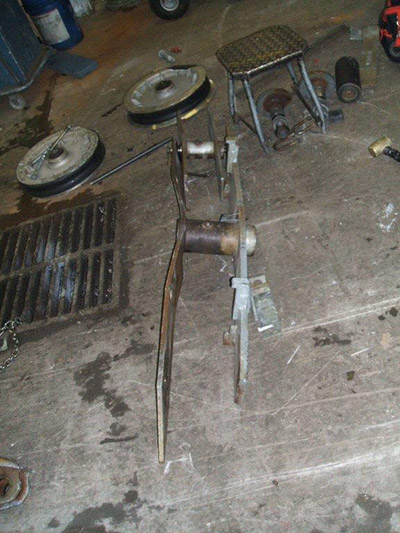
Bent sheave frame from ice loads
Mt Bachelor and Mt Hood Meadows both enjoy working in the same weather as Timberline. There is also a lot of information and learning coming out of New Zealand where there is some big icing. I’ve gleaned some wisdom out of those areas, but from an operating standpoint, the location of Timberline is the most challenging. But while it’s severe, it’s the challenge of it that keeps you going. The people who work around this stuff for a living are high in character. I think of people like R.J. Knight who would be splicing up on Palmer with two inches of ice in his beard in his frozen coveralls while the rest of our crew was wearing rain gear. R.J.’d just keep on and finish the job.

R.J Knight at work in Aspen

Don’t miss this caption on the picture
The biggest challenge with year-round operations is we don’t have a full season of lift down time like other resorts. So we just keep working consistently between weather and schedules. We operate our lifts year-round, and Timberline has the longest ski season in North America.

Top terminal is buried

Winter storms can bring winds can be up to 100 mph at Timberline
Timberline used to be a little area, just busy on the weekends, quiet during the week, with one ski patroller. The most significant change that ever happened was the expanded summer ski operation when we built the chair on the upper mountain. That changed the whole picture of Timberline and how it turned into a world-class destination during the summer months. Funny — a lot of people in Portland who ski here in the wintertime don’t even know we ski in the summer time. Most of our guests are from all over the world as there are a limited number of places to ski during this season.
The Palmer lift closes during the winter months. Besides the rime ice, there can be winds up to 100 miles per hour. When winter comes to the lower lands, and the boss says it’s time to put Palmer to bed, we have a system, what we call “winter assemblies” that are mounted twelve feet below the cross arms for strength. We drop and secure the rope in those assemblies for the winter.

Palmer winter assemblies.

For our lower mountain, some chairs we’ll run at night to keep them from icing up and the rest we have another system we use to get them unfrozen and rolling again. Yes – sometimes it is necessary to open late.
How I got here.
I grew up in Chicago but moved to Portland because my grandparents were here. I love the west coast.
I got hooked on skiing and in 1971 started working at Timberline, right out of high school. I was a ski patroller and a lift operator the next couple of years and then managed the ski patrol. I had that roll for a couple of years and then got tired of my feet hurting all the time wearing ski boots. I started working with the lift maintenance crew. A few years later when the lift maintenance manager quit, I almost left also for another opportunity. The mountain manager at the time told me “You can’t leave. You shouldn’t pass this position up as the new lift maintenance manager. So I stayed, and that’s what I did.
My wife Pam and I are a Timberline couple as we worked and met here. We have three kids, one a schoolteacher and two of them work in the industry. My youngest son is here at Timberline as a Rooms Manager at the hotel. My other son is a snowcat mechanic at another local ski area.
Question #1 to Bill: In all that freezing weather, what’s your favorite kind of gloves to get you through?
Answer: Kinko’s like everybody else. When they get wet – you just put on another pair.
Question #2: Your maintenance crew – have you trained most of them fresh or have you hired experienced mechanics from other resorts?
Answer: Occasionally we have experienced mechanics from other areas, and occasionally there is a supervisory roll or management position from another area. Timberline is a great company to work for, but few mechanics come because of the weather and as it’s a year-round operation.
Question #3 How’s that West Coast seafood?
Columbia River Salmon is a specialty in the hotel and is about the closest you get to seafood here.

Timberline’s family of St. Bernard’s continues with Bruno

Bruno images: photo courtesy of Terry Richard
Knight Equipment Company (Circa 1957)

Knight Equipment Company, circa 1957.
Aubrey Knight; founder, and the little guy is R.J.
Advice and Adventure from Brian Jorgenson, Timberline Helicopter, Inc

Fly day safety.
The most critical concern that can save time, money and stress on a fly day is having control of the work area. Helicopter ski lift construction is becoming more difficult as resorts become year-round destinations and where people are continually on the mountain. If someone is out on their mountain bike, we can’t fly over them with loads of concrete, towers, and other supplies. We have a legal responsibility from the FAA (Federal Aviation Administration) including rules and guidelines which dictate that we don’t want to fly over people that are non-participating public.
Keeping the area clear by closing trails, utilizing trail guards while we fly back and forth is crucial. Helicopters have a tendency to attract on-lookers, but it can become distracting to the pilot trying to deal with the construction at hand while making sure we’re meeting with legal obligations as well. It may come to a crossroad where we will be taking Google Earth images and say — this is the area that has to be sterile. We haven’t quite gotten to that point yet, but there is a level of surprise at some resorts when we request work area closure. They just don’t understand that.. well, it’s dangerous.
How is a plan of action developed?
I have had a lot of experience with many of these teams from the three lift manufacturers. The construction teams and I understand each other, how we operate, and at this point, it can be a simple conversation during the briefing — this is what we’re going to do today, and this is how we are going to do it. That said – there‘s always some new people, and we have a pretty extensive safety briefing because there are a lot of ways things can go wrong and we want to minimize those concerns to the greatest degree possible. If something does go wrong, where are we going to be and what are we going to do?
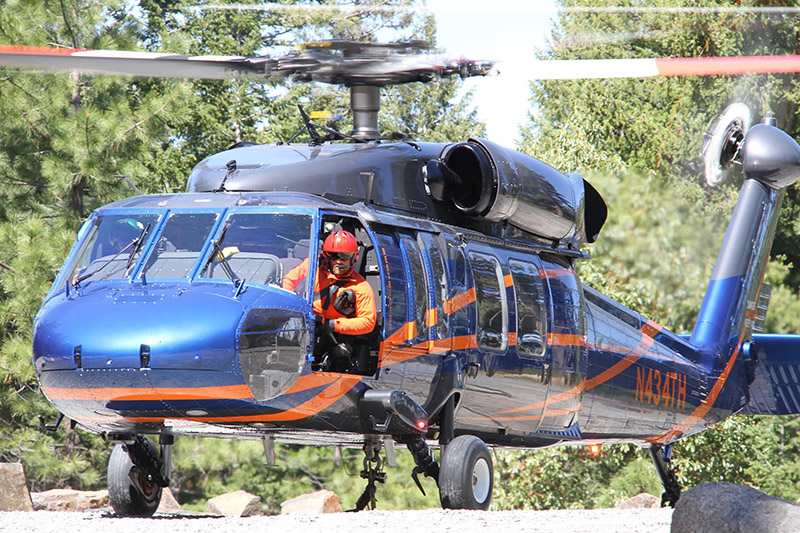
Helicopter Fleet
We have two of the first Kaman K-Max’s we started out with in 2004. These aircraft are built in Connecticut by Kaman Aerospace. We also have a Vietnam veteran Bell UH-1 Iroquois — nicknamed “Huey” and we have four ex-military Black Hawks.
My favorite to fly is whichever one I’m sitting in. Each helicopter has its challenges, and they all have the things you like about them when they’re in action.
Each of the aircraft that are out working in the field has two mechanics that work a two weeks on – two weeks off schedule. There is always a mechanic with the helicopter every day it’s operating. While mostly they are there for preventative maintenance, if something does happen to break, the mechanics are there to fix it immediately so we can get back to work.
We buy the Black Hawks directly from the military. The Black Hawks are still OD green and have “United States Army” painted on them when we fly them home. We tear them completely down to almost nothing, strip the paint, strip all the excess wires out, paint them, and install civilian radios. We have a team of six to eight people here in Sandpoint, ID that are full-time employees and a director of maintenance that oversees the fleet. It is quite a maintenance crew.

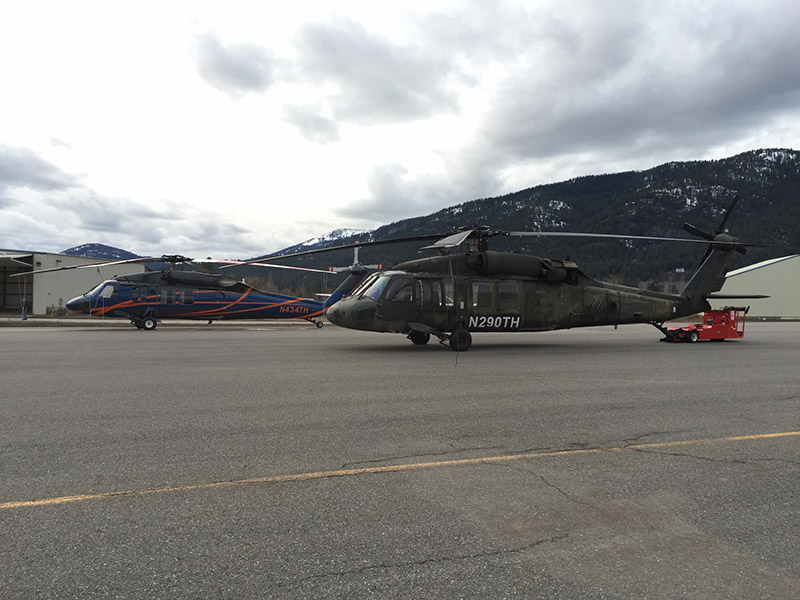
Black Hawks before and after the maintenance crew refurbishes.
While on a project — for example, installing a lift in Gatlinburg, TN, one or two of our guys will take off a couple of days ahead of time with our fuel truck and our service trailer that has all our spare parts. Then we fly out with a mechanic to be there at the site with us.
How I got started
My earliest memory is when I got my first ride in a helicopter somewhere around four years old. The ride lasted maybe a minute, and we never got higher than three feet off the ground. I remember thinking — this is fun! I want to do this when I grow up!
I began flying in airplanes because it was affordable and some of the aeronautical experience transfers to helicopter piloting, like learning about airspace and air traffic controls. I got my helicopter pilot license when I was 20 and started off my career as a helicopter flight instructor as most new pilots. It seems odd, but you teach until you have enough hours for insurance to cover you to do other flying work. After that, I went to work for my dad to be able to acquire the first K-Max and start my company. Flying helicopters has been a full-time career since I was 23.

Kaman HH-43 Husky photo credit: National Museum of the U.S. Air Force
My dad owned a helicopter company in the timber business for more than twenty-five years as an employer/owner. He owned pre-Vietnam helicopters, like a 1959 Kaman Husky which is similar to a K-Max with the same rotor system but has a much bigger body. His business model for the aircraft focused on timber logging.
Helicopter logging is used in one or two situations or a combination:
1) extremely challenging to access the terrain.
2) environmentally sensitive terrain.
The land may be a steep mountain side or wetland. It may be a combination of both or a unique kind of animal that has its habitat in the area. While there is valuable commercial timber in there, we don’t want to be building a road system. There is a lot of variation, but you fly in and take out maybe 30-60% of the trees, depending on what the management goal is. The goal may be to increase the health of the forest or reduce the risk of wildfire.
The team on the ground will hike through the timber, cut the trees down, cut off all the limbs and the tops, and then cut them into logs. Another crew comes in with cables that they wrap around and hook to the helicopter that will carry the trees from a half to three-quarters of a mile out to an existing road where a truck can access the logs. There, the logs get a final clean-up and get loaded and hauled to a lumber mill.
The crew on the ground will eyeball the size and weight of the logs. A crew member that is good at this can be within 300 pounds of his estimate. Mounted on the aircraft is an electronic strain gauge, so I know the helicopter isn’t lifting more than it’s capabilities.
In this type of work, we are hired by a lumber mill that has bought a timber sale from the U.S. Forest Service. More prevalent in recent years, we work directly for the Forest Service to achieve a land management goal. Right now we are in the second winter of a multi-winter project in Ashland, Oregon where we are working in conjunction with the City of Ashland, the Forest Service and a non-profit to log the city’s watershed. The Forest Service and the city are concerned that if they have a catastrophic wildfire, the fire will destroy the watershed. We’ve taken about 40% of the timber stand out of the woods to cut down on fire fuel and create more space between the trees.
After logging for almost a year, I was looking for fly work that is more challenging, learn a new skill set, and diversify the business. The ski lift community is small and relatively hard to break into for work. The crews on the ground make this installation construction my favorite kind of flying. They are excited and happy to be there. It’s fun to work on that team because there’s nothing there but a bare mountain in the morning and if it’s an average size ski lift, by the afternoon, we’re looking back up the hill, and there’s a brand new ski lift. Some pilots have a knack for this kind of construction work – some pilots don’t. I wish I could identify what the success factor is. We also manage ski run clearing so we can then do the entire project. We come in, cut the trees, fly the trees, deal with the trees and provide a complete solution.
My wife Ammy and I have two kids, ages seven and nine. My family calls Sandpoint, ID home, but we also homeschool the kids so they can travel with us. We just came back from Australia where THI was hired to fight fires.

Brian and Ammy Jorgenson with their MD-530 Helicopter
How’s the weather up there?
Everybody always wants to know what is too much wind. It’s difficult to put a hard number on that because some days when the wind is blowing 10 miles per hour, you can’t find a way to work with it. Other days when it’s blowing 30 mph, you’ve never had a better day. It’s variable — what direction is it blowing from, what kind of terrain is there, what aircraft are we flying today. Whether it’s a Blackhawk, K-Max, or a Huey, all of them handle differently and have particular requirements, so there are not hard and fast limitations in such a dynamic environment.
My very first season I have learned to have much respect for the Colorado Rockies. My first week out, I got caught by one of the afternoon thunderstorms. I watched this storm build up and move towards us and was unprepared for it. I told the guys, I’m going to take one more bucket of concrete up – that was going to finish the hole, and everybody was happy as they were worried we weren’t going to get the job completed. So I took the last bucket up and had just landed –I hadn’t even shut down the helicopter, and a lightning strike occurred less than a hundred yards away. That got my attention, and I always determined that I was not going to let one of those storms sneak up on me again.
Timberline Helicopters, Inc.
1926 Industrial Dr.
Sandpoint, ID 83864
timberlinehelicopters.com
Rockland/ Rainforest Adventure Park
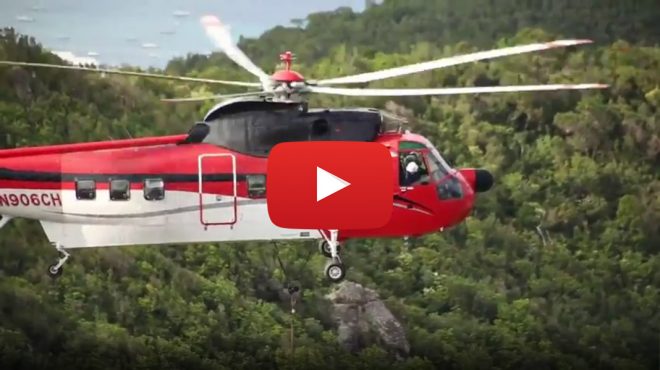
Skytrac installs two specially engineered fixed-grip chairlifts to withstand high winds from seasonal hurricanes.
HoliMont’s Light Bar — View from the Chair
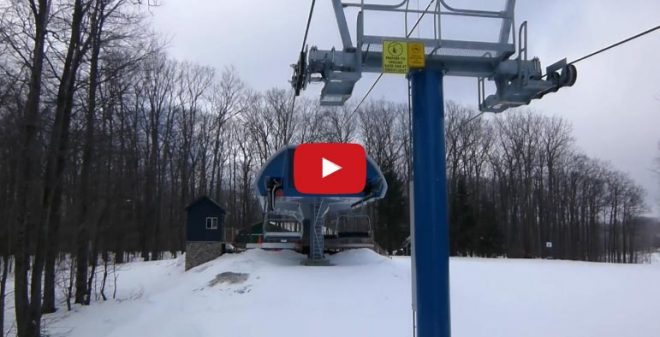
Light bars for lift ramps. This informal camera phone-video offers the experience of using a light bar from the skier’s perspective.
Dave Riley, GM, HoliMont NY
“Falling accidents usually happen where they always happen, right where the kid raises the restraining bar.
We want to keep those restraining bars down longer so that if they are going to fall out of the chair, they not going to fall as far. So we initially changed the signage on the towers to read “raise the bar at the flag,” and we placed a blaze orange flag on the com cable about halfway between the last tower and the top terminal. Nobody got it. Nobody figured it out. Nobody paid attention to it. It was after that I’m in Austria, and I see a light bar system and I was like — wow -this is much better way to do it. This is clearly the better system, so I plagiarized it.”

