Author Archives: Skytrac

Dave Riley Isn’t Bored Anymore

Writer’s note for reading this article: If you know Dave, you’ll understand that is written just as he speaks .. loaded with his humble, wry humor.

Bill Merk bought a Tucker Snowcat and trailer to carry people up the mountain for skiing. A small building with a center fireplace and a gravel floor served as the lodge. It was also the place where the Tucker was stored so you cooked your hot dogs while sitting next to the Snowcat.

In 1962, this was another one of HoliMont’s options to get you to the top of the mountain for skiing.
In the mid 1960’s, the pickup was replaced when the area bought their first lift– a used Von Roll.

A little history

“I got heavily involved with the HoliMont Ski Club in 1980. I was running a manufacturing plant in Warren PA, and our chief engineer was a member of the club. My wife and I had sold our house in Michigan, had not bought a new house yet, and we were kind of bored. Our chief engineer said “Hey Dave! You used to ski in high school, come up to this place called HoliMont that I belong to!” He spent the day with my wife teaching her how to ski and dumped me with the Hill Committee, which was the governing committee for the mountain. I had a lot of experience that was transferable – maybe not..[chuckle]. I became part of the Hill Committee that day. Here I was, just in for a visit; my wife decides she loves skiing and here we are becoming members of the ski club. From 1980 to 2000, I was a very active member of the committee. We bought lifts, snowcats, ordered diesel fuel, did all types of stuff. In 2000 the President put his arm around me and with the retiring general manager took me to dinner with too much wine, and said “Dave we want you to manage the club, don’t think about the money..think about the quality of life.” And here I am, a GM of a ski club, after 27 years of running manufacturing plants.

What sold me on HoliMont was the sense of family. My wife and I had two children while we belonged here, a daughter in 1983 and a son in 1986. The club was a family place and comfortable. There was one time I was skiing in the master’s program, and my daughter had a fall in race training. While a patroller was attending to her, folks here chased me down until they found me — and I wasn’t GM at the time. HoliMont people know each other and become close friends. My daughter was taught by a coach here and ended up teaching that same coach’s daughter how to race years later.

In the continued development of the area, we educated ourselves, used statistics, and connected with other resorts for advice. Some of the first connections I had were with Jim Vanderkelen, founder of SMI, Whistler Resort, and a ski hill out of Detroit called Mt. Brighton.
This industry is unlike the manufacturing business. In manufacturing, you don’t help each other, you’re competitive. This is an industry that if someone has a problem, there’s someone else who will help out in any way they can. It’s a breath of fresh air.

We have eight lifts here, and I was involved in specifying and purchasing all of them except two Borvigs from the 1970’s and 1980’s. We installed the detach ourselves a few years ago. The lodge has also grown, and we’ve added 15-20 expansions or upgrades [to the original building] since 1980. There are nice tiles in the restrooms, marble countertops. It’s very rustic and doesn’t feel exclusive.

Like most ski resorts, we use real estate development to fund infrastructure.
Back in the 1960’s when Bill Merk was selling this club, he persuaded twelve or thirteen people to get it started. When you joined the club [in those early days], you automatically got a land lot to build a home on. Bill sold a season’s pass and a lot together for around $600 bucks. Looking at that same lot now, it will sell for about $160k. I have a friend here that’s one of the two original remaining members that still has his receipt from Bill Merk.”

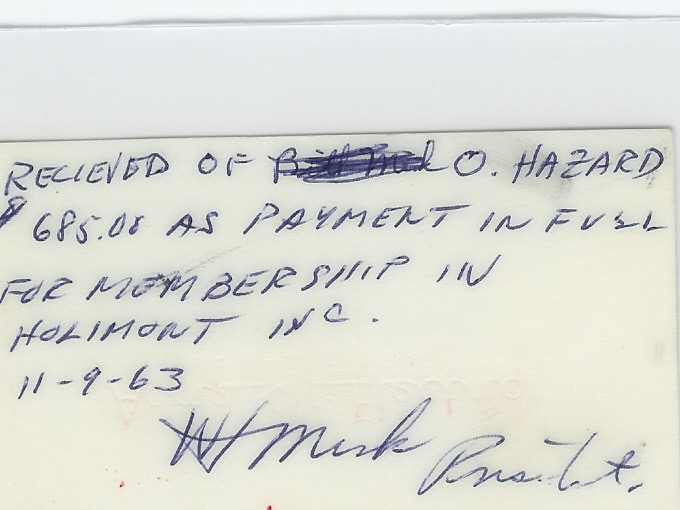
$685.00 receipt written on the back of Bill’s Merk’s business card. This sum included a season’s pass a residential lot on the mountain to build on.

Greer Ski Slope operated around 1938 until the early 1940’s. An old Model A was anchored on a cement block so that the rear axle and wheel could serve to drive the rope tow.

“When we purchased the land where Greer Hill Ski Slope used to be, the chief engineer and I laid out the slope using the same line but wider than it was in the 1930’s and 1940’s. It’s a north facing slope and steep at 31 degrees.”

Rock ski obsolescence.
“Years ago you used to have two pairs of skis, You had skis for when the snow was good, but when the snow was bad, you had your rock skis. Nobody in this day in age even KNOWS what a rock ski is. That’s because we have the technology to make snow conditions very good all of the time. And those are the type of upgrades that you have to do because that is more and more what the marketplace is demanding.”
John Dalton’s Lifted life in the Caribbean

This article has all the non-fiction action pack you could want: tower drama, helicopter drama, hurricane drama, with rum distilling and history older than your resort.

John Dalton is outside in St. Maarten while we talk. He’s in balmy, shirtsleeve temperatures, almost 2000 miles due South of me. This laptop and I won’t leave the room with the loaded woodstove.

While I was aware that John Dalton is the chief engineer for Rainforest Adventures, a company that develops outdoor adventure parks, my starter questions quickly discovered that John is one of us. He has been dedicated to the ski industry, and specifically to chairlifts, since the early eighties. He has an exceptional playbook that we’ll learn about later in this article.
But first, the lift project.

Searching for an adventure park


John Dalton at work. The next step back was a doozy.

“When we were first searching for a destination, we went to several locations around St. Maarten. In each of our parks, we have a mission statement that includes education, conservation, and value creation. Some examples of our conservation include our St. Lucia park, where we have 1,250 wooded acres. It was important to the people living there that the hardwoods were left to grow, so we kept them. We had a similar experience with trees in Jamaica where the government owns our leased land. In Costa Rica, we purchased the land around our parks, where this property works like a buffer. Here in St Maarten, it’s a little different because the native force was gone a long time ago. The piece we decided on was the last intact plantation with an old plantation house built in 1740 by John Philips, the governor of St. Maarten. The house had lost its roof in a 1995 hurricane and never got patched up and the structure was in bad shape. We completely rebuilt it to its historical glory. The architect used the same foundation for its restoration. It has an original stone barn where they used to make rum and, in the reconstruction, we used historically correct trusses. It is interesting to think that the original trusses would have been built by shipwrights using wooden dowels. That stone barn is going to be the park’s bar and restaurant.”


Plantation House before restoration

“The story of this particular plantation is a point of pride locally because a gentleman by the name of Emilio Wilson bought this land in 1954. His great grandmother was a slave born on the plantation and Emilio fell in love with the property and kept it whole. He could have sold it easily but held onto it until his death in 2002. It changed hands and ended up being owned by the government. We had to be patient to get this project off the ground with five years waiting and planning and one year for building.”

Writer’s note: This island was settled by both the French and the Dutch in 1648, hence a North and South divided island of St. Martin—French and Sint Maarten—the Netherlands.

Hurricane designs

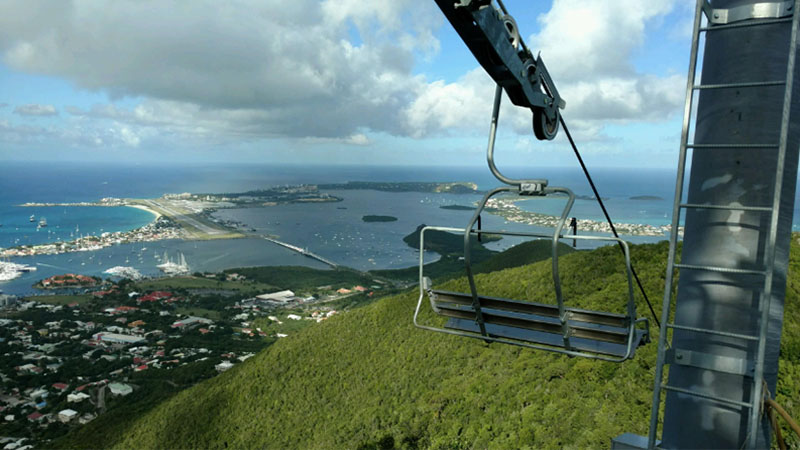
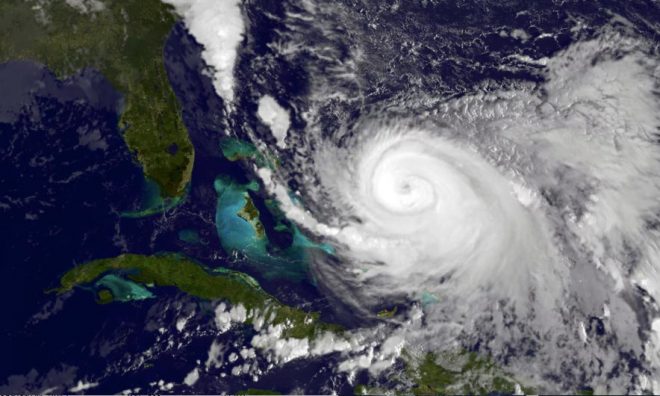
“The mountain itself is the highest point at 1096’ on the Dutch side and has the best views on the island. This peak is a challenging place for construction. The top is all rock and precarious. For the top return terminal’s foundation, we were required to hire a Dutch geotechnical engineer. We received a second opinion from a structural engineer from MIT and, along with my experience, we came to the same conclusions on how to approach it. We decided to deter the weight concerning the faults in the rock while considering the direction of the trade winds blowing. Then we applied a hurricane design as these lifts are more exposed than any lift we have done before. These lifts will see accelerated winds in a hurricane on the top of the mountain so we designed it to manage 200 miles per hour winds. I worked closely with Ross [Palmer] at Skytrac to find an optimal design to keep the towers as short as possible. The philosophy is if there is a big hurricane the sheave trains could get bent a little bit, which is repairable. We can drop all the chairs and leave the cable on. We maximized the loadings on all the sheave trains so that cables will hopefully stay on in high winds. In the worst case, there will probably still be one cable left on the tower, reducing the stress a little and hopefully not get any towers bending. We have short stubby little towers anchored into the rocks. With all that we’ve put into consideration, that top terminal is going to stay put.”

Local rock

“The common name for our rock is Blue Bitch. The name comes from its blue tint and its a real bitch to work with. I brought in a friend who’s been a blaster all his life and he built the foundations in St. Lucia. Due to the fractured nature of the rock and possibility of large boulders ending up in local neighborhoods, we decided not to use any dynamite so we drilled and use expanding grout.”

When helicopters meet trade winds

“Construction of three terminals were done using a helicopter. The challenge here was the trade winds hit the front face of the mountain and created lift. The pilot would have a load of concrete under him and had the pitch on his propeller at zero with no torque, and the helicopter was still lifting. The trade winds were gusty, and he was struggling trying to get back down to the staging area with all that lift. The pilot kept playing with it until he found a technique that included heavy G forces, which meant putting the machine on its side and slicing down the hill rather than floating down like a leaf. That was something I’ve never seen before. It took him an afternoon to figure how to do it, and then he easily took a minute off of each turn that saved us a lot of money. The guy was good.”

Haul ropes in the tropics

“We have experienced some critical corrosion issues at Rainforest Adventures. We closed a tram on the island of Dominica because it was built about a mile and half from the Boiling Lake, a volcanic lake. Once in a while, it would send a cloud of sulfur down the valley, and our equipment would develop rust overnight. We fought that with stainless steel bolts, marine-grade wiring and painted, painted, painted. One night I was laying awake thinking about the towers. We bought an inspection camera, cut holes in the tops of the towers and dropping the camera inside to see what it looked like. We closed the tram the next day. It was kind of scary. Yeah. It’s something that normally doesn’t happen to tramways but the fact that the towers were not galvanized, not dipped, no protection on the inside of the tower. The corrosion took us out after ten years.”

Experience

John started in Grand Junction working for Poma in 1983 working on and off for twenty-five years. He was also employed with Leitner on two separate occasions and also a few years for Doppelmayr. Since then, his career has been consulting to ski resorts, lift manufacturers and then exclusively the Rainforest Group for the last fourteen years.


Andy Pierce of AP Electric; Jeremy Shank; John Dalton
Jeremy is the son of the well-remembered Kevin Shank of Big Sky, Crystal Mountain,WA and nine years for Rainforest Adventures.

“The reason why I’ve stuck with this industry is the vast majority of people have a passion for skiing. Between high school and university, I clipped a year off and headed to the Rockies and worked at Sunshine Village. I spent the year learning how to ski and getting addicted to the mountains. After that break, I decided to go back to school get my engineering degree. It took me six years to complete my four-year degree because I was skiing four days a week.”

“My forte is in doing lift profiles, just like Jan Leonard—who liked doing profiles a lot. I wrote the profile program at Poma. When I started in the 80’s, we were using satellite connections to a computer in France to run the profile programs. It was a bit of a bother for us to use that system here in America, so we decided to look into writing a program that met the American code. I ran the algorithms and mathematics along with a friend of mine who is a high-end programmer. I guess it was around 1992, I had this dream to sail around the world, and I would work on this profiles program while sailing. I bought a little boat and sailed around the world in four years and came back in debt with a big smile on my face. I started building lifts again to save up for another boat.”

“I’m down in St. Maarten living on my next sailboat, and I hope when this project finishes that I can take off cruising again. It takes a lot of patience to put these projects together. Much of it is in cultural acceptance I’d say. And there’s considerable satisfaction when it all comes together. St. Maarten is my seventh lift in the tropics. If I include the double gondola in Australia for Poma that would be nine lifts since 2002.”

A special Skytrac thank you to our fixed-grip friend and colleague, Andy Pierce, for his many work-site photos.

Conversations with Ross Stevens

Professional Engineer and life skier on today’s ski lift culture, lift projects, and his take on differing ANSI Standard interpretations.

“The mid-eighties was my ten-year career mark in civil, structural, ski lift and tramway engineering — the engineering I loved the most. At this point in time, I decided to venture out on my own and start Stevens Engineering. I’m a New Englander and the 80’s was also a time when chairlifts were becoming prevalent at Waterville Valley, Loon Mountain, and other expanding resorts.

“Technology for ski lifts has advanced light years since then. But design processes for lifts has also evolved to lessen mechanical failures as well. During those mid-eighties, we were mostly concerned about equipment failures resulting in accidents and affecting public safety. If a serious malfunction occurred, the news would catch national attention. Design engineers like myself would try to mitigate those types of occurrences from ever happening again. As the adage says ‘there is no better teacher than experience.’

“I had done a lot of lift inspecting, modifications, and upgrade projects and was hired by major manufacturers in various states. I also was designing lifts on my own. Those were the Jan[Leonard] days with CTEC. Jan and I worked together a lot. He was like a brother to me and we spent years on the ANSI B77 Committee as I started attending in 1978. There were fewer people at the sessions back then. Being involved, all the members got to travel to great places and associate with the most prominent engineers and industry experts. I learned things I wouldn’t have otherwise. I’ll emphasize that being involved with the ANSI B77 Committee was a tremendous influence on my career.

“Throughout the years, the committee has formulated new additions and major revisions to the ANSI Standards. These advances have helped to improve safety by developing better inspections and testing methods for new and existing lifts as well as advancing standards for the design, operation and maintenance of passenger ropeways. Much attention has been given to lift component design. Even lift evacuation processes have improved through the committee’s efforts. The result is, there has been more job creation like NDT specialists, wire rope inspecting, and risk management positions to name a few. I also believe throughout these years that some of the best lift mechanics and professionals remain in this industry because of their fundamental love for and commitment to winter sports.”

Differing ANSI Standard Interpretations:

When asked my thoughts on industry participants developing their individual interpretations of the ANSI Standard guidelines, I believe it happens for two different reasons:

Reason 1
“Industry participants may not always have an awareness or good understanding of a particular guidelines in the Standard, so they use their perceptions to carry out their projects to the best of their ability.”

Solution: “Their best resource is to reach out to people who are on the ANSI Committee or familiar with the use of the ANSI Standard. I’m available to help, and there are others who can point someone in the right direction about guidelines in the Standard or refer them in their area of question (i.e.) electrical, hydraulics, etc.”

Reason 2
“Others who may use their individual interpretations are industry professionals involved with the committee. These are forward thinking people who are trying to improve upon the Standard and would like to have other members accept their ideas for improved standards.”

Solution: “Instead of using a personal judgment, even if highly experienced, there is a traditional system of approving changes by collaboration within the ANSI subcommittees or ad-hoc’s that lead to a final consensus vote by the entire committee. It is a process of education with any new proposal because of the variety of disciplines within wide categories of Committee membership, including manufacturers, independent specialists, employee, government, allied industry, etc.”

New projects on the table:

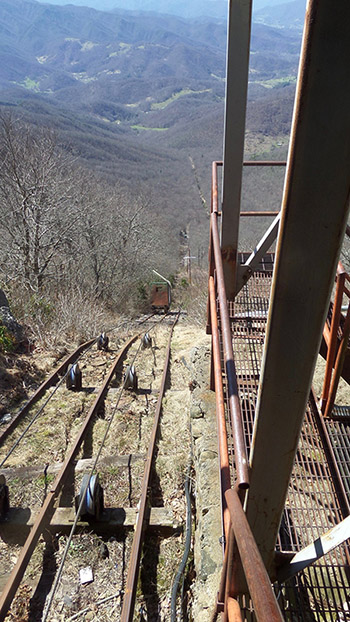
“I always like projects that challenge me technically and I am fortunate to be involved currently with two funicular projects. One of the projects in Mt Pisgah, NC I’m redesigning from the ground up. It’s a 60-year-old mountain tram installation that has been shut down by the state. It needs to be substantially reengineered and reconstructed to current ANSI standards. It is a service tramway – no passengers other than infrequently transporting technicians and equipment to the television and utility transmitting stations at the summit.

“The process of planning and initiating the upgrade began about a year ago. One of the first steps was the tram needed to be usable and safe for the purpose of getting materials to the top for necessary immediate repairs. The cars are small and hold about 3000 pounds of weight. After repairs, the tram will be suitable to transport a select number of maintenance people up the mountain to install additional safety systems. Then this tram will be used to construct the new funicular. We will replace the track and machinery in the top station and a new drive at bottom station. The project is on forest service land and needs appropriate permitting. We’re at least a year out to completion.

“Another type of project I enjoy is working with the non-profit ski areas. Many of these are coming back into existence after the original skiways lay dormant for decades. These organizations bring the sport of skiing and boarding back to the community at a low cost.”


“Stevens Engineering designed a new rope tow for Mt. Eustis in Littleton, NH, and the volunteers built it. The area was able to open in 2015-16 season. We did the same for Ascutney Outdoors who operates the tow rope at Mt Ascutney, VT. They also installed their rope tow with volunteers. The Ascutney land trust agreement was of national magnitude. They offer free skiing to the community. As they climb their way to success, they have high aspirations of installing an additional lift in the future.”

“It gives me a tremendous amount of fulfillment working with these organizations because I believe they appreciate qualified services and their new equipment as much as, or maybe even more than for-profit resorts. Watching people ski at these places and having new growth to the industry is a personal reward.”

Ross A. Stevens, PE
STEVENS ENGINEERING

PO Box 1945
New London, NH 03257
Tel. 603-526-2493
Mobile 603-491-3959
Email: stevenseng@comcast.net
Website: stevens-engineering.com

LeRoy Shultz and… Can You Guess Who?

Win a Skytrac hat!

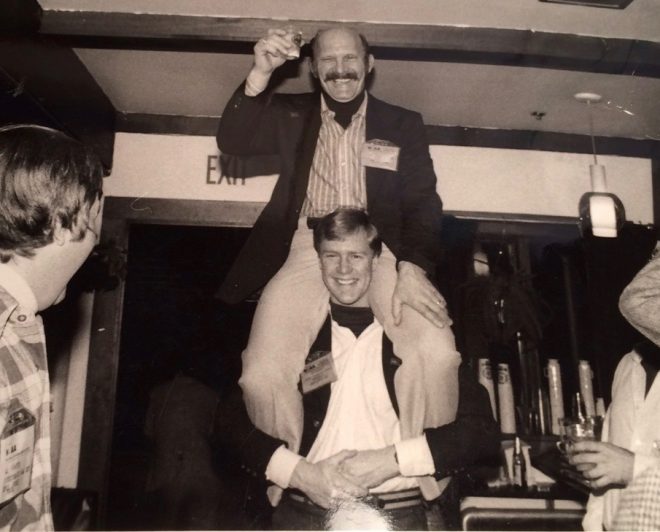
Last June, LeRoy Shultz, Engineer and past chairman of the ANSI B77.1 Committee received the Jan W. Leonard award for exceptional contribution to the Committee. We caught up with his wife Dana who sent us this wonderful picture of Leroy accepting his award. Thanks Dana!

But WHO’s the rugged ivy-leaguer-looking guy carrying LeRoy in the retro 70’s photo?

Be the first of three people to post the right answer and we’ll send you one of our super cool, limited edition Skytrac hats. (Skytrac and L-P team – shhhhh)

Paint Your Tucks and Don’t Overlube

Generations of Advice from Mountain Wire Rope Services.

Is your team prepared for your upcoming splice or will you fall back on old habits? JT and Whitney Walters-Anderson give us the basics for Splice Day that often get overlooked.

Pre-Splice Day
Mountain Wire Rope will ask for the original splice report, original rope specs and any records up to this splice service. “These records provide us with an understanding of what’s been done for service and changes up to this point” says Whitney.

“Your Splicer may not have any experience with your crew, especially if you’ve had a turnover in mechanics. It’s important for the Operations Manager to teach their staff the basics on wire rope.. what a tuck is, what a strand is.. thedifference between a strand and a wire.”

Splice Day
JT: “The haul rope should be lowered to the ground before your splicer gets there. If you have the ability to get the rope positioned in a good work area, usually the middle of the hill [typically the highest and flattest area] it makes the job easier on everyone.

The most important thing on a splice is the rigging. In keeping with a schedule, understand that the rigging can often take more time then the splicing. Make sure the rope is safely secured and tight, with the splice area flat. Outside of that, an ATV and a generator are equipment the resort should have ready-on-hand.”

Splice Maintenance
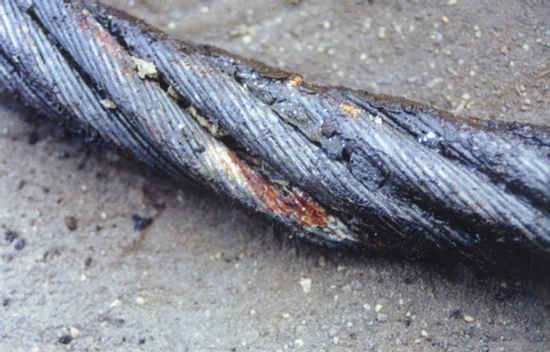
“When going through your visual inspections, the splice is the place most prone to deterioration. It’s here where you can spot potential grip damage as grips should never be placed in the splice area. The tuck is larger than the rest of the rope and this causes the grip to migrate into the splice. The grip gets caught in the tuck and gets hung up. The continual traveling of the rope on this splice area gets worked on and worked on until damage occurs. Recommendation 1: Paint your tucks! Recommendation 2: Place chair #1 where the splice is on your haul rope [takes out any guess-work].”

“We often get a service call and a mechanic will say –We have a broken strand! –Cell phones are great in this case because we have the mechanic take a picture and text it to us. Sometimes a picture diagnosis can nail it in finding a solution for the resort. In the past we would have to travel to the resort to see what was happening. Usually we know pretty quick that it’s a broken wire in the strand and not the whole strand.

Another maintenance concern: over-lubrication. Using too much lubricant causes breakdown of sheave wheel liners which in turn causes a build-up of liner material in the valleys of the wire rope. The magic measurement per foot? One gallon per 5000 feet of rope. Doesn’t sound like enough – but this is correct.”

Three generations. The story we’ve been waiting for.
Whitney reflects on her start with her dad, Dale Walters.

“It was always a conversation in the family – what was going to happen to the business [after dad]? I grew up with Mountain Wire Rope, going to trade shows, job sites and I knew the basics. I was in the fashion industry in the rat race of NYC and was unhappy. I approached my dad about joining the business, and he thought it was a good idea. I completed my two-year apprenticeship and was one of the only women in this business. I ran into women in the lift department, but not very often. I had to work hard to prove myself.”

JT also grew up around his dad’s shop with a background in welding and fabricating. After proposing to Whitney and adding to the now Walters-Anderson family, Dale had heart surgery and needed an additional person out in the field. JT was ready. “We were on the road working so much; sometimes I didn’t know if I was married to Whitney or Dale”, JT jokes.

MWR recently added a Magnetic Rope Testing machine to their service line-up. This MRT analysis performs an x-ray of the haul rope, specific to detachable lifts. While JT and Whitney received this training and certification on the MRT, the Anderson’s announced that their son Jake (pictured in this article as both an 8-year old and a teen) also earned his certification as an NDT Rope Inspector. Another generation continues the heritage of Mountain Wire Rope Services.

Mountain Wire Rope Service, LLC
570-286-0644
splicer@ptd.net
mountainwirerope.com

From Macy’s to the Kullberg’s; The Success of Mt. Peter

Karl Kullberg sits a bulldozer visually surveying the resort around him as he has done for the past twenty-six years. While he talks, he points out all the qualities and features about the mountain; he knows every detail. Mt. Peter is a family-owned ski resort and when there is an opportunity to talk to long-time area owners, you feel nostalgia…almost a chapter of Americana. Much like talking to a rancher or farm owner who knows when every post was planted, when every stair was built.

Despite the season last year and the southerly location in New York’s Hudson Valley, Karl is pretty matter-of-fact and positive about the coming years for this resort:

“Mt Peter is a family mountain and I live here on the property. My wife’s parents live above the lodge. When you walk around the mountain every morning with your cup of coffee, you see what needs doing. In season, I’m here 24/7. When there are issues, I’m right here to take care of it.

We are a learn-to-ski mountain. We have very successful programs—250 kids in our race program alone. We have to make good snow. We have to have good grooming and the lifts need to be running well for it all to work [successfully] for our skiers.

We are 50 miles outside of NYC and have a unique ski history. Macy’s Department Store built the ski area and back then it was a couple of rope tows. But this was the place where the clothing suppliers would meet, look at winter fashions, smoke cigars and drink whiskey. Babe Ruth learned how to ski here. Camelback Resort investors eventually bought it from Macy’s and then Don and Gail Sampson bought it from Camelback. The Sampson’s purchased it with no money down, putting up their house as collateral. We celebrated our eightieth season last year.

I was raised here in New York and was a ski racer in my younger years and attended the ski academy at Pat’s Peak, when they had one, and, after that, Squaw Valley. Those were the days of long and skinny skis. When I moved back to New York, I began coaching at Mt Peter and eventually married Rebecca Sampson, the owner’s daughter. I ran the race department and after nine years became the mountain manager. I was literally drilling holes for a racecourse and would get radioed to help at a lift.

My wife Rebecca and daughter Brianna and son Kei are all skiers. Kei is a Junior GS National Champion.

I have worn my Mt Peter hat all over the world and everywhere people approach me because they have learned to ski here.”

Jan Leonard Inducted Into the Intermountain Ski Hall of Fame

Among others honored, the late chairlift engineer Jan Leonard was inducted into the Intermountain Ski Hall of Fame this past September 21 at the Alf Engen Museum, home of the Intermountain Ski Hall of Fame.

“Leonard founded one of the most recognizable ski-industry companies in the world. A 1968 graduate of Penn State, he was building bridges when gondolas and chairlifts captured his imagination after his first visit to a ski area in 1970. Six years later, he cofounded the Cable Transportation and Engineering Corporation (CTEC), which became North America’s leading lift manufacturer. By the 1990s, he’d successfully navigated industry mergers, and in 2002 was named the president of Doppelmayer CTEC. He became a founding member and principal of Skytrac, another lift engineering and construction services firm, in 2008. He died in August 2015, after undergoing heart surgery.” (Alf Engen Museum)

Says Carl Skylling, Director of Sales and principal of Skytrac Lifts, “Having Jan receive this honor means the world to us here at Skytrac. While we miss Jan hovering over his desk, designing and mentoring in his office down the hall, we believe he would be very proud of the company’s direction and success in the last year. Jan’s legacy continues.”

The Rebuilding of a Historic PA Ski Resort

In 1938 when the Mellon’s developed Laurel Mountain as a private ski club, the Ligonier Valley was a playground for the wealthy with fox hunting, trout fishing, and the Rolling Rock Club. This valley was where the Westinghouse, Carnegie and other famous Gilded Age families mixed socially for holidays away from the city heat and work pressures.

“This was a time when Pittsburgh was the 6th largest city in the US. The Laurel Mountain Region was to Pittsburgh what the Catskills were to NYC and the White Mountains were to Boston. The Industrial Revolution started here because of Pittsburgh’s three river-ways that created natural access to the city”, says Jim Shultz, an owner of Mountain Works Corporation.

Mountain Works, located within a few miles of Laurel Mountain, installed a new fixed–grip quad lift, completely Skytrac engineered and fabricated in Salt Lake City. It is a 2400 pph, 300 HP that replaces a 1960’s Poma double chair.

“As a 10-year-old kid growing up here and skiing here, I saw forest rangers complete with their brown ranger hats running the chairlift that the state installed. The ski club only had a t-bar and you couldn’t believe it! It was a double-diamond t-bar. You better hold on!

The ski area sat with no activity from the mid-eighties until 1999 when a new group came in and invested in a new lodge, groomers and modern snowmaking. They installed a used quad chair and got the Poma double chair operating and installed a tubing park which they thought would be a sure key to success. They ran it for about ten years.

The resort sat for 12 years when local people, having history and a big heart for the area, found Governor Ed Rendell in a tour bus – as the story was told – and asked the governor to consider earmarking funds and commit to the revitalization project.

The project broke ground last October of 2015. Seven Springs Resort, less than 25 miles to the North, will operate as the concessionaire. This arrangement will offer great options for skiers.”

Ligonier Construction, located in nearby Laughlintown, was awarded the general construction contract that  included removal of the existing chairlift, site clearing and trail grading.

“Obviously, we’re excited about the progress made there and are very appreciative,” said Alex Moser, marketing director for Seven Springs and Hidden Valley. “We’ve done a lot of collaborative work there with Ligonier Construction and with the state.” (Paul Peirce, TribLive)

“During a celebration on the reopening progress, Robert Nutting, Seven Springs Resort Chairman said, ‘Our partners—DCNR and Ligonier Construction—have made tremendous progress in helping us push towards our goal of reopening Laurel Mountain. This is a renowned skiers’ mountain with a unique and proud history. By reestablishing the ski area as a community asset, it will bring with it new jobs, activity and the ability to attract even more visitors to our region.We look forward to realizing our goal and celebrating as the first skier takes the first run down Lower Wild Cat and the steepest terrain in the commonwealth is reopened for all to enjoy.’

Operation of the resort by Seven Springs would be the latest development in the history of one of three ski areas privately operated on Pennsylvania state park land. Once the exclusive winter playground of Rolling Rock Club members, it [Laurel Mountain] opened in 1939 and later was deeded to the state. Laurel Mountain is among the first ski areas in Pennsylvania” ( excerpt from First Tracks!! Online)

Back to the Future With Sam Geise

What were you doing 18 years ago? 
Comparing ski industry notes and some personal ones, from 1998.

You’ve been an engineer in the ski resort industry for 29 years; that’s nearly three decades of your neighbors watching you put your skis in your car when heading to work. You got your start in the wire rope business. How did that happen?

“I got started by pure chance: I was flat out of money, my wife and I had a new baby boy, and I needed a job! I had just graduated from Oklahoma State University and wanted to move back East. My brother Peter Geise, who was living in Sunbury, PA at that time, sent me an ad from the Sunbury Daily Item regarding a position for a project engineer at the Paulsen Wire Rope Corporation.

“My family and I drove an old police car I had bought for a few bucks at an auction through the worst snow storm on record. It took us forever to drive from Oklahoma to Pennsylvania. We felt like pioneers going in the wrong direction. Fortunately, I got the job. Peter later became a Paulsen Wire Rope salesman.

“We supplied wire rope to lots of businesses: coal mining, fishing, construction, elevators (I once rode the elevator at the World Trade Center on top of the car), and ski lifts. Most customers were dirty, grumpy people until I visited a ski area where everyone was smiling. Maynard Russell asked me if I knew an engineer interested in working for Pettit-Morry, a former ski area insurance company and I said – ask me! So he did.”

In 1998, you spoke about the value of experience. You remembered a time when you calculated, for reasons of economy, a design using minimum beam sizes for a crane to lift bobbins of wire rope. Your calculations were spot-on, but when employees used the same beams for raising forklifts, the beams bent like “a willow tree in the wind.”  Do you have any other examples where best design intentions didn’t follow through for everyday applications?

“Some years ago in Innsbruck at the Interalpin show, I spotted a duel track snowmobile. It was an Alpina made in Italy. I thought US ski areas would love this vehicle as a work machine as it functioned between a snowmobile and a groomer. I bought one, brought it to the USA with the idea to import and sell them to ski areas. However, without a dealer network, a place for parts and repairs, this idea was not going far. It didn’t. I sold two and passed the business on to the next person. I am fond of the expression ‘we learn more from our mistakes than our successes.’ “

You were also quoted in 1998 that, in your opinion, the most serious problem facing the industry today is “the US industry’s inability to invest in new technology”. Your thoughts today?

“Today I think the USA is missing out on manufacturing. In manufacturing, you learn new inventions to make things better yet less expensive. It reflects the old expression, “Necessity is the mother of invention.” If [tiny] Germany can design and build the best automobiles in the world, then we can make some great things here. Skytrac is a good example. I’m for free trade. There is no reason why the US government can’t help US companies that want to manufacture things in the good old USA.”

In all your years of inspecting, give us a funny blunder that lift mechanics or operations tried to cover up during inspections. 

“Once I was inspecting the stop gate of a rope tow in the winter. By skiing through the gate I noticed the stop was delayed. I tried this a few times and one time happened to look up at the top attendant. The gate didn’t work. He was watching me and pushing the stop button in the lift shack when I passed through the gate.”

Are you still the president of the Mid-Atlantic Audi Quattro Club?

“I gave up the club presidency long ago, but I’m still an Audi nut. I’m on Audi number 6. Still have Audi number 3, an S6 I took to Watkins Glen in 2012, still able to hit 125 on the back stretch.”

Sam Geise is the President of Geise Engineering, Inc.
(570) 490-2818
samgeise@ptd.net

Palm Springs Tram to Okemo Chairlifts – It’s All Relative

Nicholas is a snowboarder.

When comparing any climate that has chairlifts, maintaining a tramway in a desert area doesn’t have as many differences as you would anticipate. When talking about the lifts in Southern California, our hot weather here is equal to the snow and cold of somewhere else. It’s all relative.

Most of us who have chairlifts during extremely cold temps know to keep the heaters functioning on auxiliary motors, brake systems and to keep the overall motor-room ambiance warm enough. Considering the location of our motor-room of the Palm Springs Tram in the desert valley, we swap those heaters out for air-conditioners.

Uniquely enough, the Palm Springs top terminal is typically 45 degrees cooler than the valley terminal. It’s up there, at 10,804 feet, that the same ice and cold weather issues apply but without the extreme rime ice of the Northwest or the freezing rain of the Northeast.

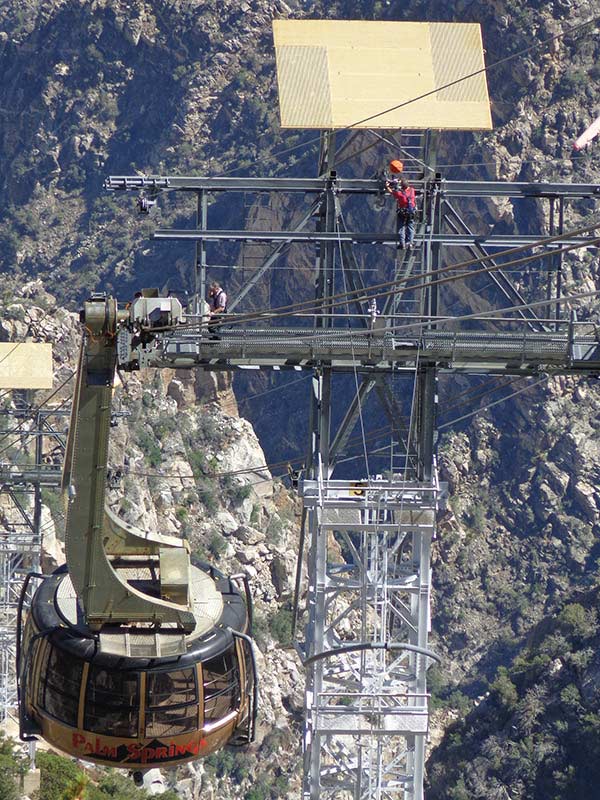
Our tram is a Garaventa originally built in 1963. In 2000, Garaventa rebuilt it with bigger rotating cabins in addition to new drives and tower heads, so my perspective is on maintaining a 16-year-old tram. While I might be envious of the control systems and newer features of the Roosevelt Island and Portland trams, I have essentially moved out of an old small “fixer-upper” home and into a brand new fancy multi-million dollar mansion.

When asked about tramway maintenance issues, I will have a similar answer – that it is all relative in our industry. While I have had plenty of days on icy detachable chairlift towers removing rime ice and prying haul ropes back onto sheave assemblies, at least ski area chairlifts, other than gondolas, don’t have door issues. For example, back at the tram, we recently had a loading dock door challenge caused by a moth that warmed itself overnight by sleeping on a door sensor. The next day, this sensor prevented the doors from functioning and that prohibits the whole tram from running. While that seems to be silly on one hand, on the other I had an equally odd experience years ago back East at Okemo Mountain, Vermont. The first day on the job I was handed an outdoor winter uniform and a solid heavy metal bar regularly issued as a lift operator tool. At this time, I was ignorant to lift issues and immediately thought it was a prank. Nineteen years later, I understand how often and how incredibly thick the clear ice can cover a chairlift bail in that region.

Another example, with respect to regions, would be of working in Central Washington State. In this high desert, we knew that annual line sheave greasing had required no more than three full pumps (to feel bearing cavity pressure) of a large, manually operated grease pump bucket (as long as the hub was center-punched for seal retention). However, maintaining the exact same lift in the western Cascades required however many pumps it took to remove all of the water from the sheave bearing’s cavity. So again, it’s all relative. These differences, I feel, only makes our industry even more interesting.

Some stats and facts on the Palm Springs Tramway:
We have 13 mechanics employed, but that includes all areas of responsibility: four lodge facilities, three wastewater treatment systems, restaurant equipment, high voltage power lines accessed only by helicopter, and many other vehicle, fabrication, carpentry, or jack-of-all-trades responsibilities. The Tramway runs about 350 days a year; 3,061 hours, 17,653 trips.

A few of my thoughts on the potential of more urban tram installations:
If trams will benefit major cities half as much as Roosevelt Island’s 2.5 million annual commuters or Portland’s 2.1 million hospital tramway commuters, then these installations cannot happen soon enough. On the other side of the coin, I would imagine that major cities would have an easier time recruiting trained maintenance personnel versus smaller ski resort towns with a smaller economy – as long as the pay was high enough to support living in the urban area. I bet that, similar to ski industry professionals, it would be a personal decision to become an urban mechanic, based on whether it was closer to relatives or parents, a resume builder, a unique opportunity, a change in economy or lifestyle. Again, with this issue especially when you factor in the very different lifestyles, it’s all relative.

Nicholas Clesceri is the Vice President of Maintenance for the Palm Springs Tramway and ASNT Level II Inspector, Mechanical and Electrical technician with NJC Advisers, LLC.

Nicholas can be reached at:

NJC Advisers, LLC
Beaumont, CA
O 760-969-4373
C 760-668-6064
njc@njcadvisers.com